Blog
Blog
Insights on attention, neuroscience, and creative testing — what we’re learning as we build North AI.

643,339 views. 231 likes. Here's what the first four seconds did.
Whatever Ralph Lauren's paid flight cost, it bought 98,998 views of a film whose best moment arrives fourteen seconds after the viewer is handed a skip button. We scored every beat with 179 simulated viewers. The creative is not the problem.
How North AI builds your target audience
Every simulation starts with an audience built from your real market context, not a generic panel. Here is how we turn market signals into behavioural profiles that react like real people, and why that matters before you spend on media.
Before you ship AI-made creative, run this 4-step audience check
Generative AI has removed the cost of creative production. The cost has shifted to creative judgment. Here is a repeatable pre-launch loop that uses audience simulation to validate AI-made assets before spend, not after.
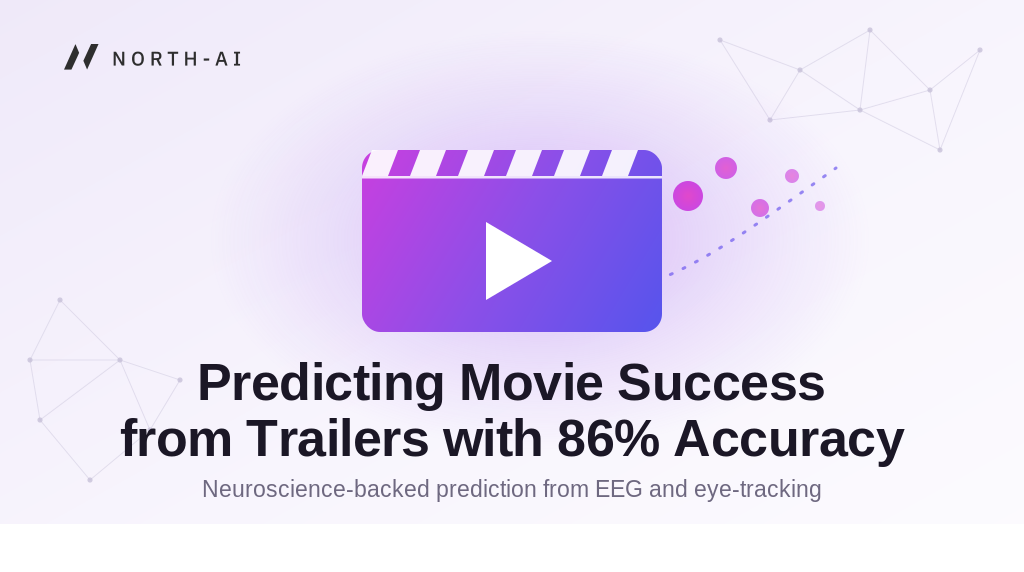
Predicting Movie Success with 86% Accuracy from Trailers Alone
A North AI neuroscience study. 24 respondents watched 20 movie trailers while we captured EEG and eye-tracking simultaneously. Models predicted a trailer's Metacritic class with 86% accuracy — and gaze synchronisation turned out to inversely predict critical acclaim. Here is what the data showed, and what we are not yet claiming.
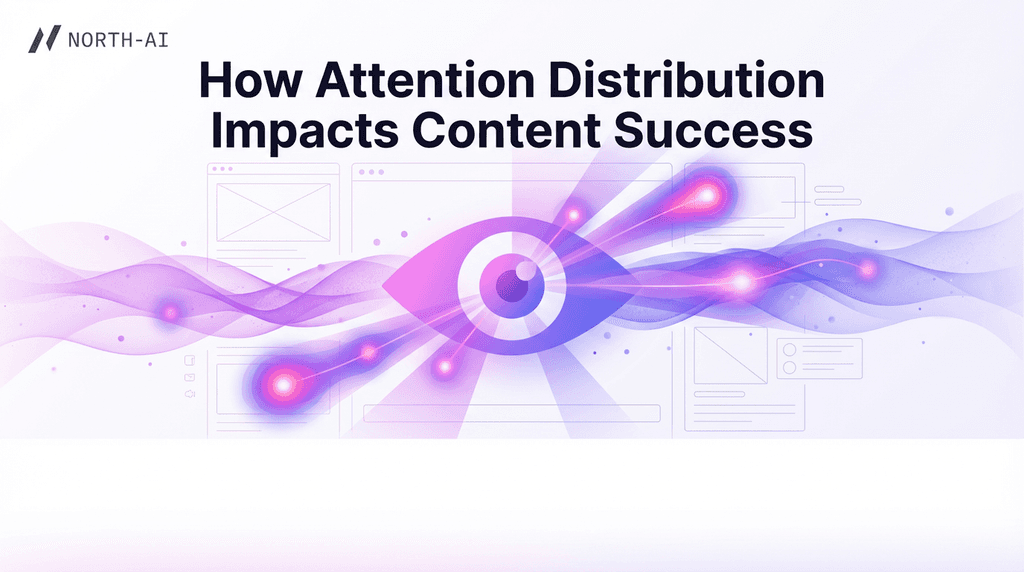
How Attention Distribution Impacts Content Success
A neuroscientific study conducted by North AI. 301 participants across the US and Canada were eye-tracked while watching 6 promotional videos. Gaze synchronisation and spatial entropy data revealed which moments engage audiences — and which don't.
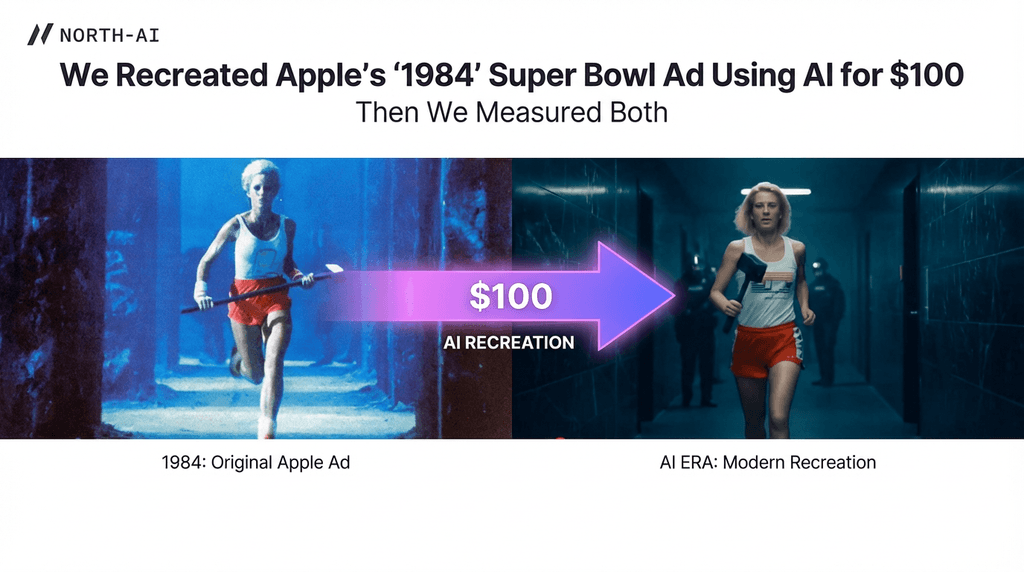
We Recreated Apple's '1984' Super Bowl Ad Using AI for $100. Then We Measured Both.
North AI's cognitive analysis platform compared an AI-generated shot-for-shot recreation of Apple's famous '1984' Super Bowl ad against the original production. Average variance across 8 cognitive and behavioural metrics: 10.11%.
We Predicted Every Outcome of Wistia's $60K Video Ad Experiment
We tested Wistia's $1K, $10K, and $100K video ads using 60 participants and simulated cognitive testing. Five prediction formulas correctly rank-ordered all six campaign outcomes before seeing any real results. The $10K video won every metric. Single scores and questionnaires both failed. Pre-launch attention testing predicted the same winner as Wistia's $60K ad campaign, for under $1K.
We Spent £600 to Validate a Billion-Dollar Question: Branding or Storytelling?
We replicated Google's branding-first vs storytelling-first study using 33 participants and £600. North AI's General Score correctly predicted the winner: branding-first achieved 1.4x higher completion. Early branding didn't increase skip rates, the balanced approach scored lowest on shareability, and every self-reported metric was identical across versions. Neuroscience testing matched Google's Brand Lift findings at a fraction of the cost.
The 8-Second Brain: Why Video Ads Die Before They Start
Human attention spans have dropped to 8.25 seconds. 85% of video campaigns fail within the first 5 seconds, not from bad creative, but from failing to earn attention fast enough. Neuroscience shows emotional processing fires 5x faster than rational evaluation, and the amygdala decides relevance before conscious thought begins. Brands winning the attention battle test hooks independently and use neuroscience metrics, not opinions.
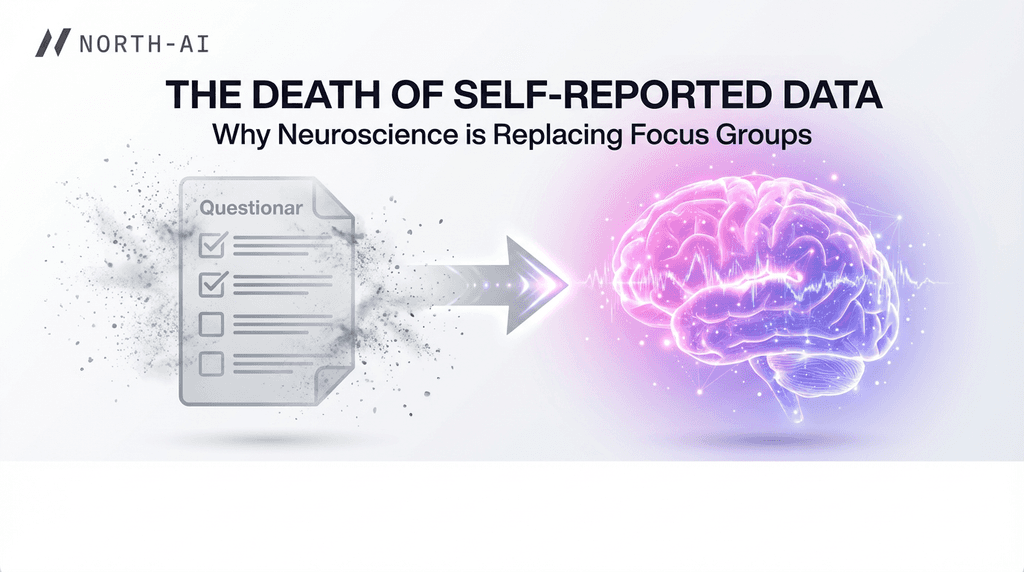
The Death of Self-Reported Data: Why Neuroscience is Replacing Focus Groups
Focus groups cost $50K+ and measure what people say, not what their brains do. Up to 95% of consumer decisions happen unconsciously. Neuromarketing, projected to reach $21.3B by 2030, captures blink suppression, gaze synchronisation, and micro-expressions in real time. Neuro-contextual ads deliver 3.5x higher neural engagement. 88% of neuro-based packaging tests outperform traditional methods. The shift from self-report to brain measurement is accelerating.
Why Your Marketing Team Is Flying Blind
Brands spend $190B+ on video ads yearly, yet 85% fail within 5 seconds. Traditional options ($50K focus groups or launch-and-hope) are slow, expensive, or wasteful. Remote neuroscience testing now captures gaze synchronisation, blink rate, cognitive load, and emotional activation via webcam at a fraction of lab cost. AI prediction models hit 90% accuracy vs 52% for human intuition. The testing gap has closed.