Before you ship AI-made creative, run this 4-step audience check
Generative AI has removed the cost of creative production. The cost has shifted to creative judgment. Here is a repeatable pre-launch loop that uses audience simulation to validate AI-made assets before spend, not after.
The problem is not volume
AI image generators now produce more creative variants in an afternoon than a studio could ship in a quarter. That sounds like freedom. In practice, it is a different kind of bottleneck.
Most teams built their workflow for a world where creative was the scarce resource. You had a director, a few rounds of revisions, a clear cost per output. The natural limit was production.
When production becomes free, the scarce resource becomes attention. Your audience cannot see every variant. You cannot run every concept against live ad spend to find what works. Optimising for output volume just moves waste down the funnel.
The volume trap
A common failure mode: teams measure the AI pipeline by how many assets clear it. 50 hero images, 300 headline pairs, 1,000 social posts. The metric feels productive because the number is large.
It is not. Creative volume without audience validation is a bet. And the bet gets more expensive after launch.
Fashion brands using AI-generated lookbooks posted in 2025 saw a 34% higher return rate on items whose imagery failed to match perceived garment quality from the hero shot. The flaw was not the generation. It was shipping without checking whether the audience trusted what they were looking at.
The same pattern shows up in B2B. AI-crafted demo slides, LinkedIn image posts, and explainer animations all look polished. Before launch, they also all look fine.
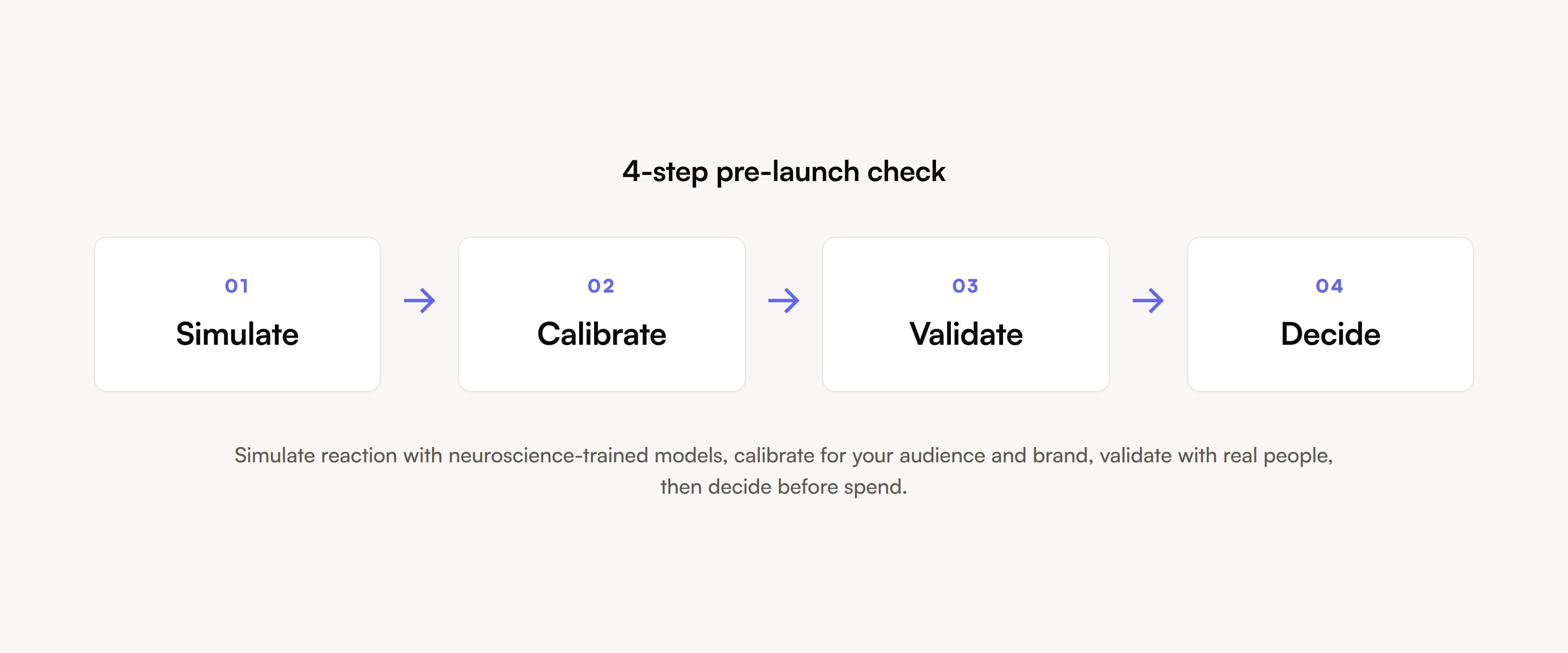
Four-step pre-launch loop
Treat every AI-made creative asset as a hypothesis. Validate it before it touches a production budget.
1. Simulate reaction
The foundation is a model trained in-lab on paired EEG and eye-tracking recordings — high-precision neural and behavioural data from real viewers. That gives the system a grounded mapping between visual stimulus and cognitive response.
From that base, we built an eye-tracking-only simulation layer. It does not need a live EEG harness to produce useful signal; it predicts attention allocation, emotional valence, and memory encoding from eye-movement patterns alone.
Before showing an asset to a single real person, you get a first-pass read on whether it will break through category clutter or sink.
2. Calibrate for your audience and brand
Simulation is generic until you tune it. A luxury fashion audience and a B2B SaaS audience do not look at the same things the same way.
Calibration narrows the model to your target demographic and your brand's visual identity. Think of it as adjusting the lens: same underlying simulation engine, different attention priors and affective responses.
This step is brand-specific and audience-specific. It is also the step most teams skip. Generic simulation is directional; calibrated simulation is comparative.
3. Validate with real people
Simulation catches the worst variants fast. For the survivors, recruit a panel matched to your actual buyer profile.
A controlled look test for imagery or a cognitive walkthrough for copy takes hours, not weeks. The point is not qualitative consensus. It is whether the signal is strong enough to justify scale.
4. Decide
Set thresholds before you start. Not after.
- Attention hold delta vs baseline: ten percent or more.
- Emotional valence: above category neutral floor.
- Recall rate at 60s: not below current control.
If all three pass, proceed. If one fails, return to the prompt or the brief. The loop compresses over time as your team learns which directions actually move the audience, not just which ones look novel.
What to measure
Clicks are a dominated metric. They measure urgency and offer fit, not creative quality. A dull ad with a strong offer outperforms a brilliant ad with a weak offer, every time.
For creative validation, lead with attention.
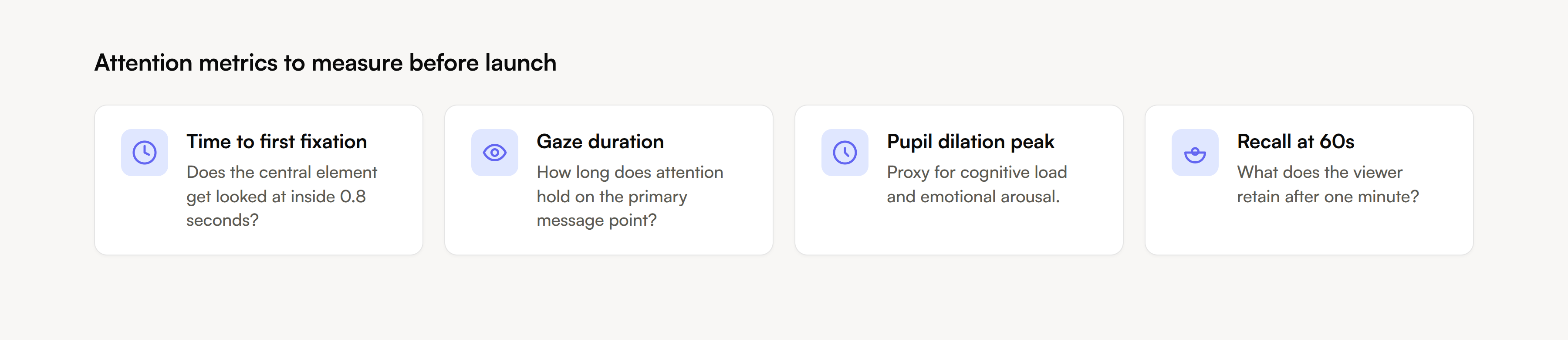
- Time to first fixation: does the central element get looked at inside 0.8 seconds?
- Gaze duration: how long does the attention hold on the primary message point?
- Pupil dilation peak: a proxy for cognitive load and emotional arousal.
- Free recall at 60s: what does the viewer retain.
None of these require full launch spend. They require a structured test, a panel, and about 48 hours.
Winners validate, losers just generate
The fashion labels that saw return rates improve this year put an audience check between generation and production. Brands that generated at scale and shipped at scale kept the same problem they had before AI: guessing what the buyer will think.
The generation step solved the wrong bottleneck for most teams. Creativity is no longer the expensive part. Judgment is.
Some have described AI as substituting human creativity. That is not what is happening. AI substitutes the production of creative assets; the demand for good creative judgment — knowing why something works — goes up.
North AI delivers end-to-end attention intelligence, grounded in neuroscience, so teams can validate creative before spend, not after. Visit north-ai.com.
Tags: #PreLaunchTesting #AttentionIntelligence #AICreative #ContentValidation #Neuroscience
Lucas Cazelli
CPO at North AI
Lucas Cazelli is Head of Product at North AI, leading product strategy and validation for the company's neuroscience-powered content simulation platform. His background is in computational simulation and risk assessment, and he splits time between London and wherever the North AI team is shipping next.
Run this in the simulator
Drop in a video, image, or copy. Get attention, engagement, and emotional response across 7 platform models in minutes.